
Step 3 / 4 — Pulse method
Pick up a melody on your instrument: turn listening into playing
From voice to instrument
After learning to feel the beat with the body and then to sing a melody, a new step naturally emerges: finding that music on your instrument.
The path covered so far follows a simple progression:
The body → The voice → The instrument
The body lets you feel time.
The voice lets you hear and memorise the music.
The instrument then lets you give concrete form to what you hear inwardly.
Playing by ear is the step where the ear guides the musical gesture.
Before searching for a note on the instrument, the musician first learns to hear it.
On mobile, use the Download link for a direct store redirect.
Why learn to play by ear?
Play what you hear
When a musician wants to learn a melody, they often use a score, a tutorial, or a model to reproduce. These tools are useful, but they do not always develop the ability to find music on your own.
Playing by ear offers another approach:
I listen → I understand → I search → I play.
The musician gradually learns to turn sound information into an instrumental gesture.
This skill is essential in every musical situation:
- learning a piece without a score;
- finding a melody you have heard;
- accompanying a singer;
- improvising;
- playing with other musicians.
The instrument becomes an extension of the ear
The goal of playing by ear is not to find notes at random on your instrument.
The aim is to connect what you hear with what you play.
The stronger this connection becomes, the more natural the instrument feels. The fingers no longer search for a solution: they carry out a musical idea already present in the ear.
The musician then develops:
- auditory memory;
- knowledge of the instrument;
- the ability to anticipate sounds;
- musical autonomy.
Exercise 1: find the sung motif on your instrument
The natural extension of singing
The first playing-by-ear exercise builds on an idea already worked on with the voice: listen and repeat.
The difference is that this time, the response is no longer with the voice, but with the instrument.
The cycle becomes:
- Listen
- Hear the phrase inwardly
- Search on the instrument
- Compare
- Adjust
The musician is therefore not simply trying to reproduce a sequence of notes. They learn to find a musical phrase.
Aids to guide listening without giving the answer
To make learning easier, several elements support the exercise.
These aids do not replace listening: they help you search more effectively.
Musical accompaniment
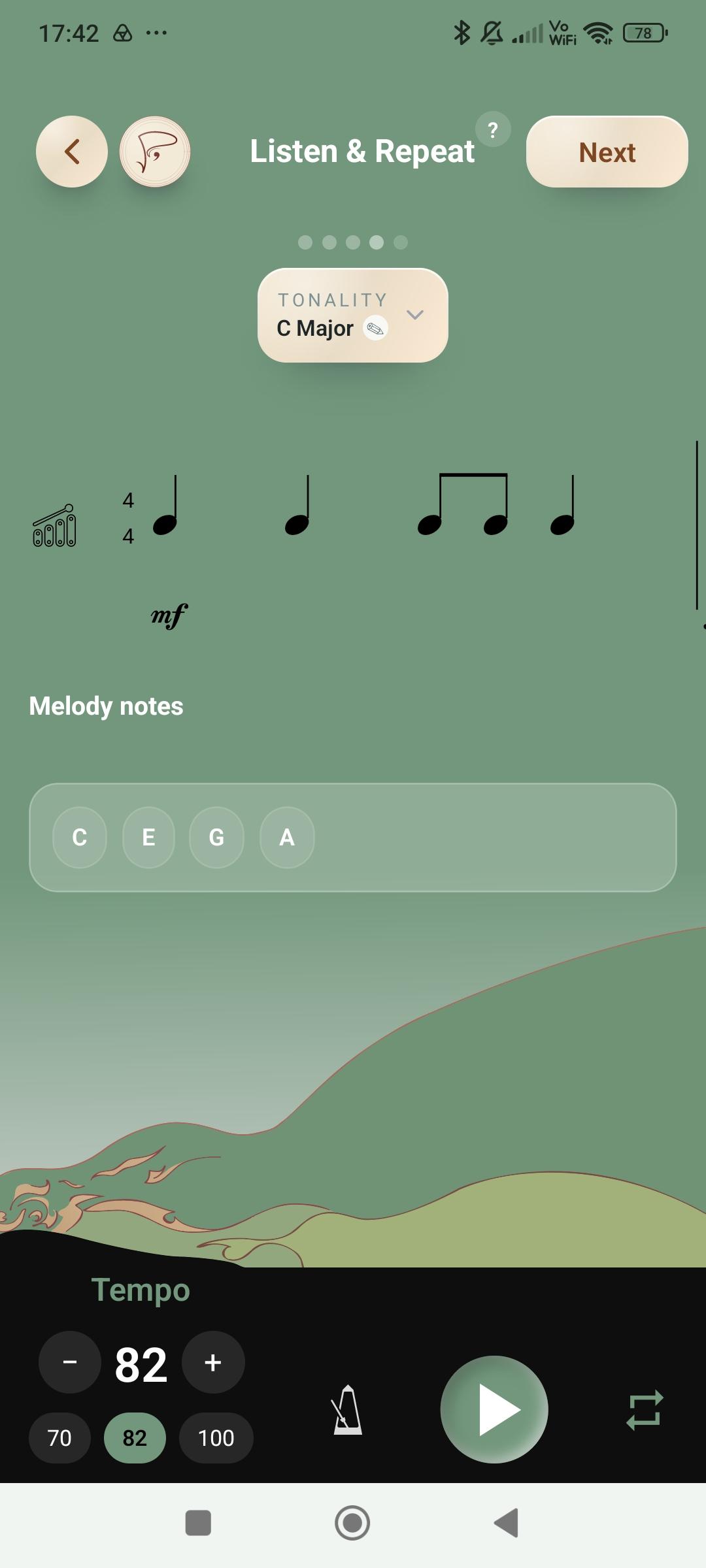
The motif is played in a musical context with accompaniment, including a marimba that interprets the phrase.
This accompaniment plays several roles:
- giving a musical colour;
- helping you feel the beat;
- providing a harmonic context;
- letting you check that you are in the right place.
But the accompaniment does not give the answer directly. The musician must always find the phrase through listening.
The rhythmic score
The displayed score shows only the rhythm of the motif.
The pitches are deliberately not written.
Why?
Because the goal is not to read a melody, but to hear it. The musician knows:
- when the notes arrive;
- how long they last.
But they must discover:
- which notes are played;
- in what order;
- what the melodic movement is.
This approach develops active listening rather than simple visual reproduction.
The note pool
To avoid searching too randomly, Pulse offers a set of possible notes.
For example, if the melody uses only:
Do - Ré - Mi
the musician knows the space in which to search. But they still have to find:
- which note comes first;
- which notes repeat;
- how they are organised in time.
The note pool creates a balance between freedom and guidance: the user is guided without being deprived of the listening work.
Finding without a cursor: let the music guide you
An important feature of Pulse exercises is the absence of a visual indicator showing where you are in the phrase.
There is no cursor showing:
- when to start;
- when to play;
- where you are in the bar.
This choice is deliberate.
In a real musical situation, a musician does not follow a progress bar. They listen, they feel, they anticipate. The exercise therefore trains this ability:
- recognising the start of a phrase;
- feeling its duration;
- keeping the beat;
- knowing where you are naturally.
The music becomes the main reference.
The role of the body in playing by ear
Even when you move to the instrument, the earlier learning remains present.
At first, you can continue walking during the exercise.
Walking helps to:
- keep the beat;
- maintain rhythmic stability;
- avoid getting lost while searching for notes.
Then gradually, the body no longer needs to express the beat through visible movement.
The sensation becomes inward.
The musician then finds on their instrument what they first built with their body.
Exercise 2: listen and respond to variations
Develop musical responsiveness
The second exercise goes further.
It is no longer only about finding a learned motif, but about developing the ability to hear a musical idea and respond to it immediately.
This is a fundamental skill for playing with other musicians.
A musician must constantly be able to:
- listen;
- memorise quickly;
- respond;
- adapt.
The principle of the exercise
The exercise alternates moments of listening and playing.
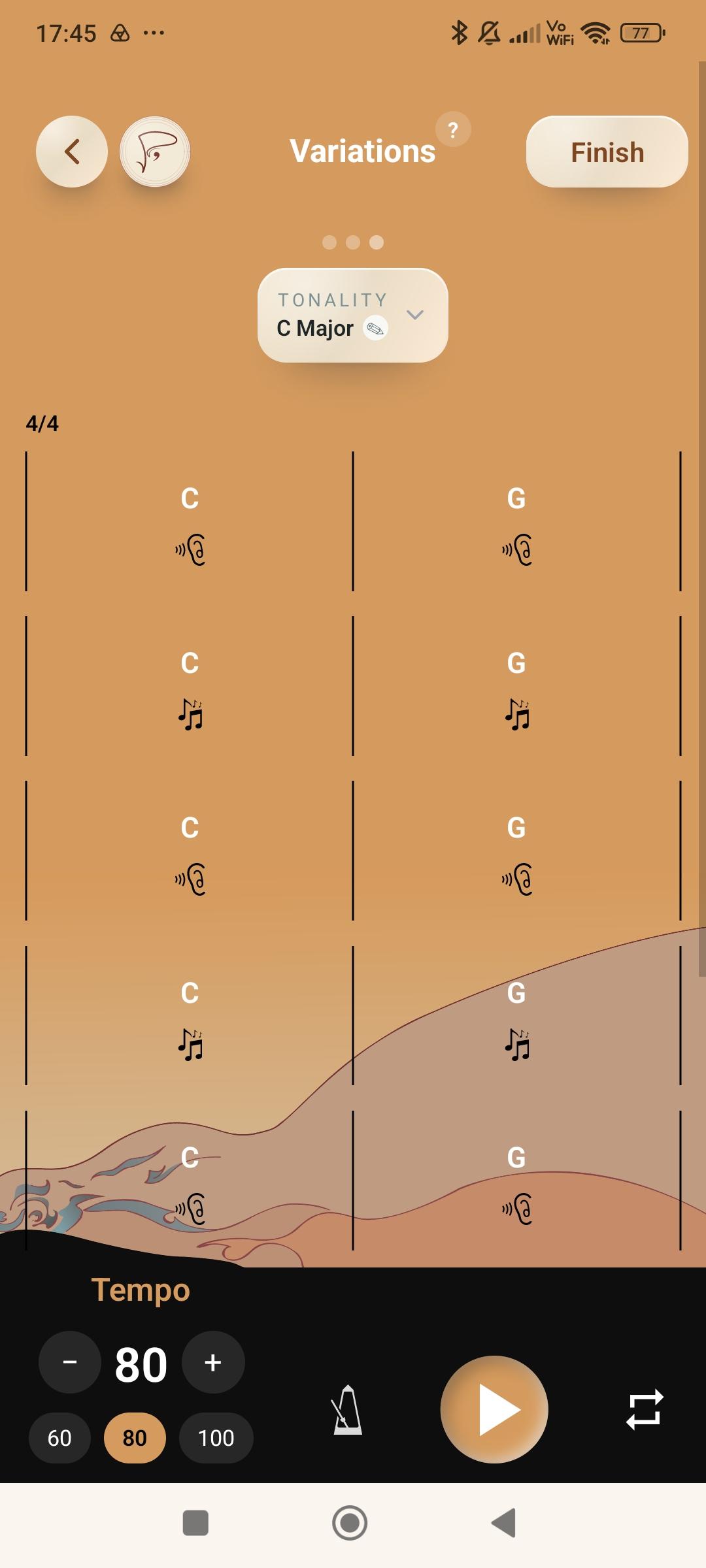
A grid shows the different stages:
| Bar | Action |
|---|---|
| 1 | Listen to a variation |
| 2 | Reproduce the variation |
| 3 | Listen to a new variation |
| 4 | Reproduce |
| 5 | Listen |
| 6 | Reproduce |
The musician discovers a short phrase, then must play it immediately.
Several variations may be offered to develop attention and musical memory.
Chords as musical context
In this exercise, a grid also displays the chords being played.
This element adds an extra dimension.
A melody never exists alone: it takes meaning within a harmonic context.
The musician thus begins to perceive:
- which notes seem stable;
- which notes create tension;
- how a melody evolves over the chords.
This is a first approach to the relationship between melody and harmony, which will be essential for improvisation.
Common mistakes
Searching for notes before listening
The natural reflex is to play several notes until you find the right one.
But this approach develops the ear less. The main question should remain:
What am I hearing?
before:
Which note should I try?
Looking at your instrument all the time
Sight can help, but it must not replace listening.
A musician should gradually be able to know where the sounds are without relying only on their eyes.
Finding the right notes but forgetting the rhythm
A melody is not just a sequence of pitches.
Placement in time is what gives a musical phrase its movement and character.
Wanting to memorise only through thinking
A musical phrase should gradually become a sensation.
Through listening and repetition, it becomes natural and no longer needs to be consciously reconstructed.
Practice tips
To progress effectively:
- sing the phrase before playing it;
- listen several times before searching;
- start slowly;
- use walking if necessary;
- repeat motifs several times;
- prioritise accuracy over speed.
The goal is not to find a note quickly, but to strengthen the link between the ear and the instrument.
What this step prepares
Playing by ear is a key step in developing an autonomous musician.
After learning to:
- feel the rhythm;
- sing a melody;
- find notes by ear;
the musician begins to be able to create their own music. This step naturally prepares:
Improvisation
Improvising requires being able to hear a musical idea before playing it.
Playing in a group
Playing with other musicians requires listening, reacting, and adapting.
Learning pieces
Finding a musical phrase by ear becomes a natural skill.
What this exercise will develop
You are not only learning to find a few notes.
You are developing skills that will be useful throughout your musical practice:
- linking the ear to the musical gesture;
- memorising musical phrases;
- anticipating sounds;
- understanding the relationship between melody and harmony;
- developing your autonomy;
- learning to play what you hear.