
Step 2 / 4 — Pulse method
Sing the rhythm and develop your musical ear
From body to voice
After learning to feel the beat through movement, a new step naturally emerges: giving the rhythm a voice.
The body helps you feel time, walking steadies the beat, and hand claps express the rhythm. Singing adds a new dimension: it connects what you feel with what you hear.
The voice is our first instrument. Before playing a melody on an instrument, you need to be able to hear it inwardly and reproduce it.
In the Pulse method, singing becomes a bridge between rhythm felt in the body and music played on an instrument.
On mobile, use the Download link for a direct store redirect.
Why sing?
The voice creates a direct link between the ear and the gesture
When a musician learns a melody on their instrument, they often go straight to finding the right notes with their fingers. Yet an essential step comes before the gesture: being able to hear the music inwardly.
Singing helps develop this connection between the ear and the body.
A melody you can sing is already partly understood and memorized. The musician is no longer just searching for random sounds on their instrument: they know what they are trying to produce.
Singing thus develops several fundamental skills:
- musical memory;
- ear accuracy;
- the ability to anticipate sounds;
- understanding of melodic movement.
If a musical phrase can be sung, it becomes much easier to recall and play.
Singing in Pulse: feel the rhythm and the pitches
In Pulse, singing is not limited to rhythmic work. The goal is to actually sing the melody, with its rhythms and pitches.
The musician therefore works on two complementary dimensions:
Rhythm
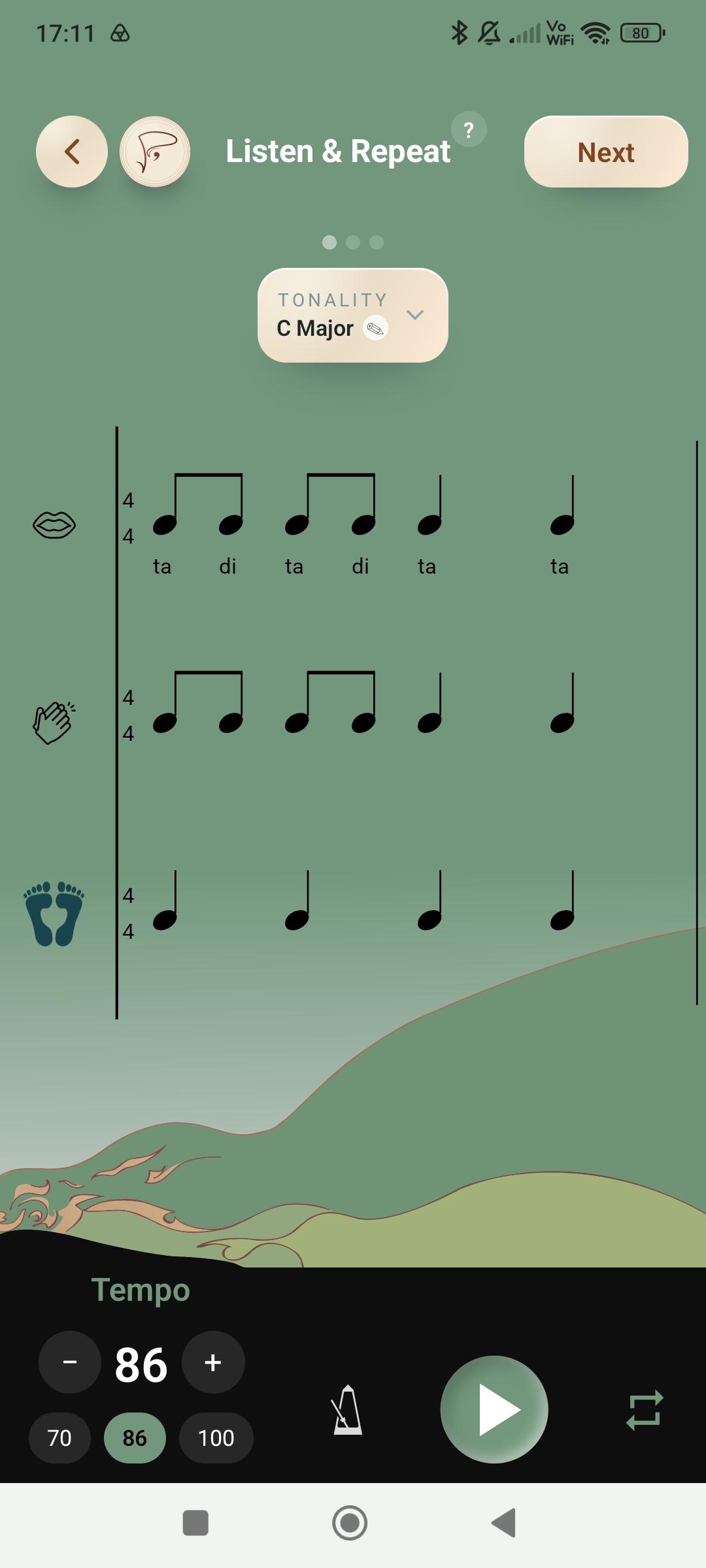
Rhythmic syllables provide a simple language for different note durations.
In the first volume, exercises mainly use the syllables:
- ta on the beats;
- di for off-beats.
They let you feel and name rhythmic movements without having to go immediately through theoretical reading.
Rhythm becomes something you can hear, say, and feel.
Pitch
At the same time, the melody is sung with its actual notes.
The musician therefore learns to coordinate two essential pieces of information:
- when the sound should arrive;
- what pitch it should have.
This link between rhythm and melody is fundamental in any musical practice. A musical phrase is not just a sequence of notes: it is movement in time.
Why use rhythmic syllables?
Rhythmic syllables give rhythm a language.
Even before reading a score or talking about rhythmic values, the musician can feel and express what they hear.
Saying:
« ta-di ta »
represents a rhythmic movement in a simple, immediate, and musical way. These syllables support several aspects of learning:
- memorizing a rhythm;
- identifying a temporal organization;
- communicating a rhythmic idea;
- better linking listening and movement.
They do not replace reading music, but they create a bridge between sensation and understanding.
Why keep walking and clapping?
When you add singing, it may seem easier to stop body movements to focus only on the voice.
Yet it is precisely keeping these elements that makes the exercise especially effective.
In musical practice, rhythm, melody, and movement are never completely separate.
In Pulse exercises:
- walking maintains the beat and keeps the body connected to time;
- hand claps express the rhythmic structure;
- the voice develops the ear and the melody.
This coordination teaches the musician to do several things at once, as they will need to when playing an instrument or in a group.
The body therefore remains a reference, even when attention shifts to the melody.
Listen and repeat with the voice
As with body percussion exercises, the work always begins with listening.
The goal is not simply to sing along with the app, but to develop genuine inner listening.
The process follows several steps:
Listen
The musician discovers the melody, its rhythm, its movements, and its structure.
Before singing, they take time to hear.
Feel
The melody begins to take an inner shape. Rhythm, pitches, and movements gradually become more familiar.
Sing
The voice translates what the ear has understood.
The goal is not to produce a perfect performance right away, but to gradually bring what you sing closer to what you hear.
Compare and adjust
Listening to the model helps identify differences and gradually refine your perception.
Each repetition develops the ear.
Going further: naming the notes
For musicians who want to deepen ear training, an additional step is possible: trying to identify the notes of the melody.
In Pulse, the displayed score shows only the rhythmic dimension. Pitches are not written in order to encourage active listening.
The musician can then try to:
- listen to the melody;
- find the notes by ear;
- sing them using their names;
- then check with their instrument.
This exercise is a first approach to playing by ear.
It gradually develops:
- relative ear;
- interval recognition;
- awareness of melodic movement;
- the ability to recall a melody without a score.
Common mistakes
Focusing only on the notes
It is common to try above all to sing the right pitches and forget the rhythm.
Yet a melody is inseparable from its placement in time. The beat must continue to live in the body.
Stopping walking to sing better
When singing becomes harder, the reflex may be to lose the walk.
But these are precisely the moments when the body is most useful: it maintains stability while the voice works.
Seeking perfection immediately
The primary goal is to develop listening.
A slightly off note or an imperfect rhythm are information that helps the brain learn.
Trying to find the notes too quickly
Identifying notes is an advanced step. Before naming a sound, you first need to learn to hear it.
Practice tips
A few regular minutes are often more effective than one long occasional session.
To progress:
- listen several times before singing;
- keep a natural walk;
- start slowly;
- repeat difficult passages in isolation;
- try singing without the app to check what is truly memorized.
The goal is not just to succeed at an exercise, but to develop a more attentive and more independent ear.
What this step prepares
Singing is an essential step between bodily feeling and instrumental playing.
When the musician can feel a rhythm and sing a melody, they already have an inner representation of the music. The instrument then becomes a way to express something that already exists in the ear.
This step naturally prepares:
Playing by ear on the instrument
Finding a melody becomes easier when it is already heard inwardly.
Improvisation
A musician who hears melodic movements can create more freely and develop their own language.
Interpretation
A stronger connection between ear, body, and instrument makes it possible to play with greater precision and expression.
What this exercise aims to develop
When you sing these exercises, you are not working on a melody alone.
You are developing essential skills for any musical practice:
- linking the ear to the body;
- memorizing a musical phrase;
- feeling the relationship between rhythm and melody;
- anticipating sounds;
- developing relative ear;
- preparing the transition to the instrument.
Singing turns music heard into inner music.
It is this ability to hear before playing that then makes it possible to play with greater freedom, precision, and creativity.