
Step 4 — Pulse Method
Improvise: transform what you learn into music
Improvisation is the stage where everything you have worked on so far starts to come to life.
Before improvising, you learned to feel the beat with your body, to sing the rhythms and melodies, to listen attentively and to copy ideas onto your instrument.
Now it's time to turn these learnings into personal expression.
Improvising is not about playing notes at random.
It's learning to use a musical language that you have gradually constructed, to create your own phrases, dialogue with other musicians and tell something with your instrument.
With Pulse, you're not just trying to learn notes: you're developing the ability to create your own music.
On mobile, use the Download link for a direct store redirect.
Build your own group
Before playing, you will create your musical environment.
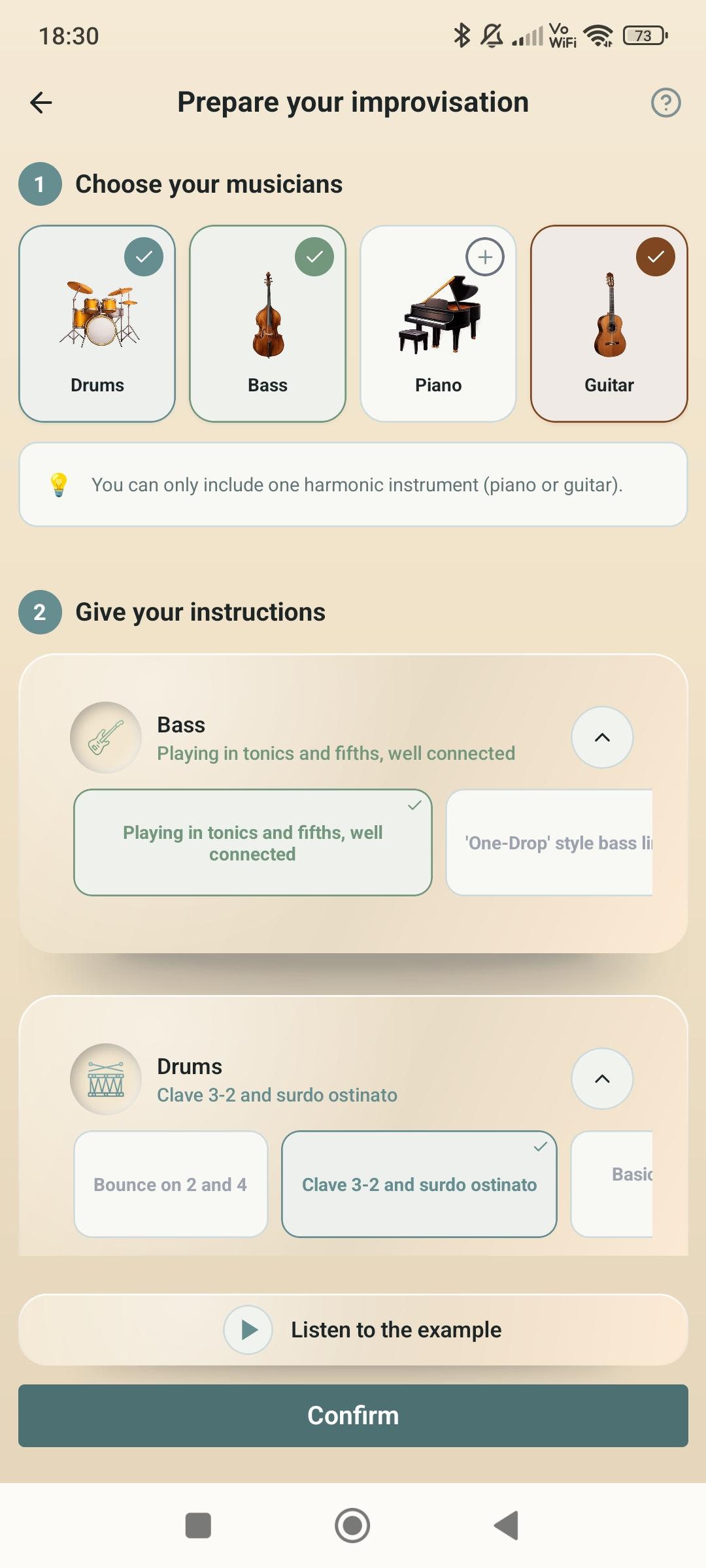
You choose the musicians who will accompany you:
- guitar or piano for harmony;
- low to support the foundation;
- drums to set up the groove.
But you don't just choose instruments.
You also choose how they play.
For example, you can ask the battery to:
- play only the beat;
- play a simple groove;
- play a “poom tchak”;
- develop a 3-2 clave.
You can choose a bass that simply plays the fundamentals or a more melodic line.
Each choice influences the way you will hear and feel the music.
Accompaniment is not decoration
In many learning situations, support is simply running in the background.
In Pulse, you become an actor in its construction.
Choosing your group requires you to listen:
- what role does each instrument play;
- how rhythm is constructed;
- where the highlights are;
- how the music progresses.
Little by little, you develop an essential ability for playing with other musicians: understanding what is happening around you.
A good improviser doesn't just listen to what he plays.
He also listens to everything around him.
Learn to play with your ears
During your improvisations, there is no cursor to tell you where you are in the music.
No progress bar.
No permanent visual indication.
No reference that replaces your listening.
This choice is voluntary.
In a real musical context, no one visually shows you where you are in the grid. You must feel:
- the pulsation;
- cycles;
- chord changes;
- the breaths.
The objective is to develop a fundamental skill:
know how to find your way in music using your ear alone.
A progression adapted to your level
Improvisation can seem difficult when you think you have to know a lot of notes or play complex phrases.
But creativity often begins with very little material.
In Pulse, exercises follow a progression.
The first improvisations
You can start with:
- a single harmony;
- some notes;
- a short duration;
- a simple rhythm.
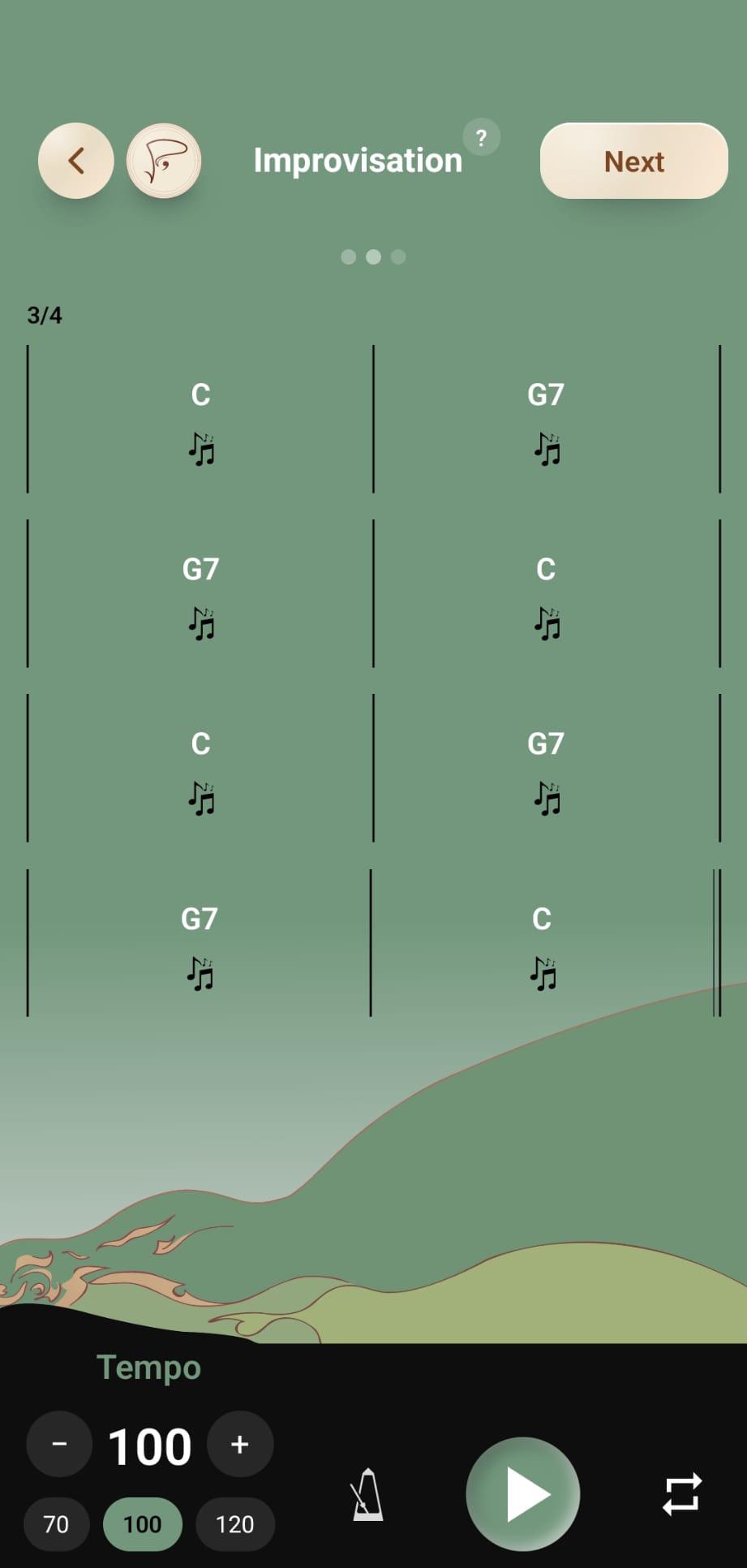
For example, improvise for 4 measures around a C major chord.
The goal is not to play a lot.
The goal is to learn how to create a musical idea.
User Improv — first chapter
Improvisation around the C major chord. Chapter “First rhythms, first notes”.
Develop your vocabulary
As you go along, you add new elements:
- the major pentatonic;
- new rhythms;
- new harmonies;
- chord changes;
- longer shapes.
You gradually learn to create more contrasts, tensions and resolutions.
Towards a real musical construction
Later, the improvisations address more advanced concepts:
- half cadences;
- harmonic movements;
- interaction with support;
- development of a pattern;
- construction of a musical discourse.
The goal is not simply to play more notes.
The goal is to better tell a musical story.
Final improv of volume 1
Improvisation at the end of the 10 chapters of volume 1.
Constraints develop creativity
A common misconception is that to be creative, you must have total freedom.
In reality, constraints often allow you to become more creative.
A painter uses a limited number of colors.
A writer uses a limited alphabet.
A musician uses:
- a rhythm;
- some notes;
- a harmony;
- an intention.
These limits provide a framework for experimentation.
Each Pulse exercise is designed as a play space in which you can explore freely.
Transform your learning into improvisation
Improvisation doesn't start the moment you put your fingers on the instrument.
It starts with everything you integrated before.
Rhythm becomes a musical idea
With body exercises, you learned to feel:
- the pulsation;
- rhythmic cells;
- accents;
- syncope.
Now these elements become sentences.
A rhythm you hit with your body can become the starting point for a solo.
The voice becomes a link with your instrument
Singing is an essential step.
Before you play an idea, you can imagine it and sing it.
The voice allows you to create a link between your musical imagination and your instrument.
Musicians who improvise easily are often able to hear internally what they want to play.
Singing before playing reinforces this inner listening.
This is how the musical idea precedes the gesture.
Transplanting builds your vocabulary
Great musicians don't create in a vacuum.
They listen, analyze and transform the ideas of others.
Copying an improvisation allows you to discover:
- how a sentence is constructed;
- how a rhythm works;
- how tension is created;
- how an idea is developed.
Then you can transform these elements to create your own language.
Register to progress
Checking in is one of the most important habits for progress.
When you play, your attention is focused on many things:
- your fingers;
- your grades;
- your rhythm;
- accompaniment.
But when you listen to your improvisation again, you change roles.
You become your own teacher.
You can look at your music with more perspective and identify what works or what can evolve.
Recording transforms an improvisation into a learning tool.
How to self-evaluate?
After recording an improvisation, avoid immediately trying to find out if it is “good” or “bad”.
Listen with a specific purpose.
First listen: general feeling
Ask yourself:
- Does my improvisation say something?
- Do I hear an intention?
- Am I leaving enough space?
Second listen: rhythm
Observe:
- Do I stay connected to the pulse?
- Do my sentences make sense?
- Do I use rests?
- Do I repeat certain rhythmic ideas?
Third listening: notes and harmony
Analysis :
- Do my notes match the agreement?
- Am I creating movement between tension and resolution?
- Do my sentences have a direction?
Fourth listening: interaction
Finally, listen to the group:
- Do I play with the accompaniment?
- Do I react to other instruments?
- Does my improvisation seem to dialogue with the music?
Start again to progress
An improvisation is not a definitive result.
It's a step.
You can :
- listen again;
- identify a specific point to improve;
- start again;
- compare your different versions.
This is exactly the process used by experienced musicians.
Progress comes from observation and experimentation.
Share and learn with the Pulse community
An improvisation should not remain isolated.
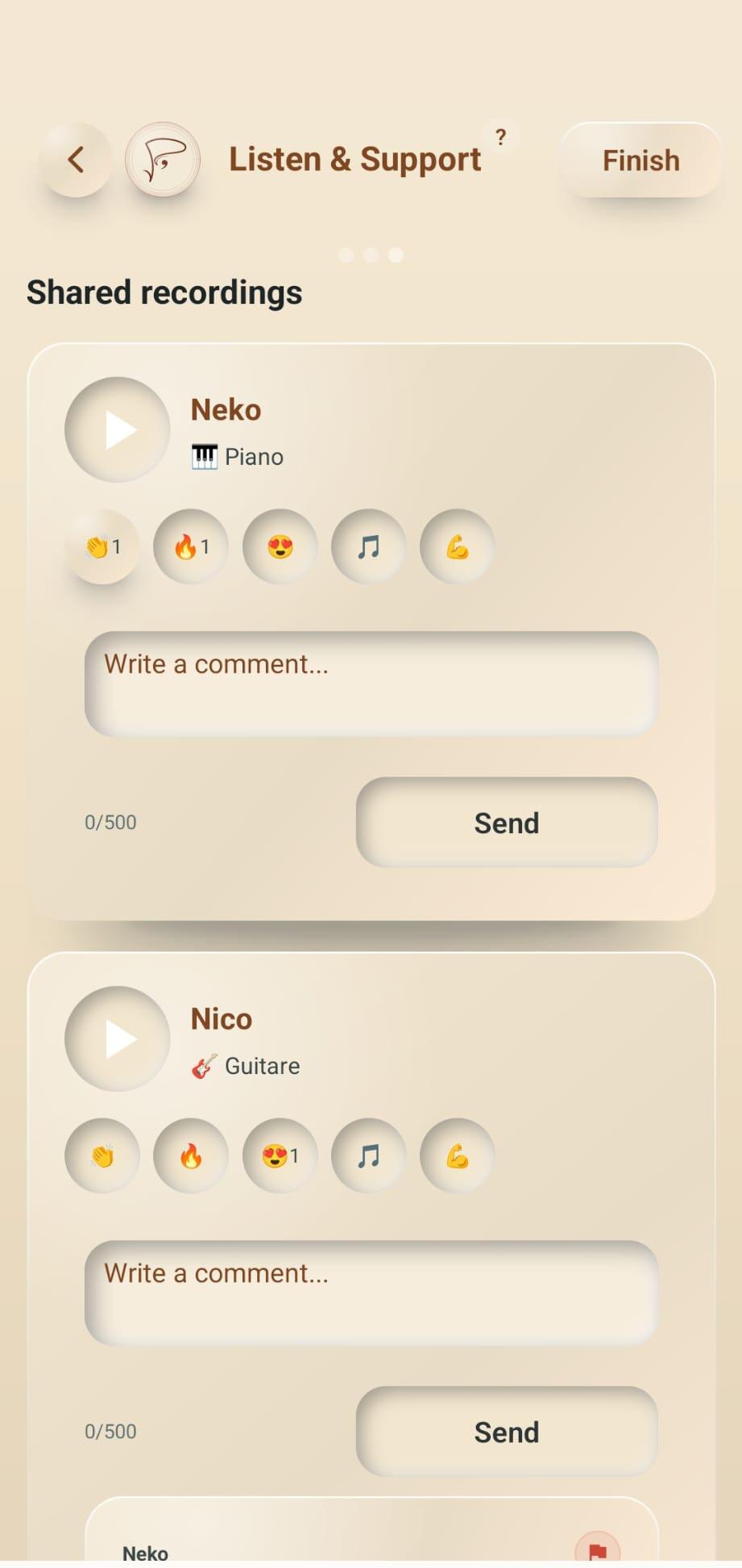
If you wish, you can share your creations with the Pulse community.
You can :
- receive encouragement;
- ask for advice;
- discover other approaches;
- listen to how other musicians perform the same exercise.
Listen to others to develop your own language
Listening is a form of learning.
By discovering the improvisations of other musicians, you can:
- identify interesting ideas;
- repeat certain sentences;
- understand different ways of using rhythm and notes;
- find new inspirations.
Each improvisation becomes a new opportunity to learn.
The same music, several tones
Not all instruments play in the same key.
Some instruments, such as the trumpet or the saxophone, are transposers.
An improvisation around a C major chord can therefore be adapted automatically:
- C major for piano or guitar;
- Bb major for a Bb trumpet.
The objective remains the same:
play together, hear the same music and develop their musical expression.
Improvising is learning to speak music
Improvisation is not a stage separated from the rest of the journey.
It is the natural consequence of everything you have developed:
- an inner pulsation;
- an attentive ear;
- a rhythmic vocabulary;
- a melodic vocabulary;
- an ability to listen and interact.
With Pulse, you're not just looking to learn notes.
You develop the ability to create your own music.