
Feature — Pulse
Changing key: a new way to progress
In Pulse, each exercise is designed to develop a specific skill: feeling a pulse, integrating a rhythm, hearing a melody, constructing a chord or improvising.
But once an exercise is mastered, it can continue to progress.
By simply changing the key, you rediscover the same exercise from a new angle.
We no longer work only on rhythm or melody.
We also develop the ear, the understanding of the relationships between keys, the cues on the instrument and the ability to react quickly.
The same lesson can thus continue to make progress for months.
This feature transforms an already known exercise into a new workout, without changing its educational objective.
On mobile, use the Download link for a direct store redirect.
Why work in several keys?
When you're starting out, it's reassuring to always play in the same key.
The landmarks become familiar and all attention can be focused on the rhythm, the pulsation or the new concepts covered.
But as you progress, it becomes interesting to get out of this comfort zone.
Replaying an exercise in another key requires you to listen differently.
We can no longer simply reproduce a gesture or memorize a position on the instrument.
We gradually learn to recognize the relationships between notes, to hear harmonic functions and to naturally find our bearings, whatever the key.
Little by little, the music becomes independent of the position of the fingers.
Two ways of working
Pulse offers two complementary approaches.
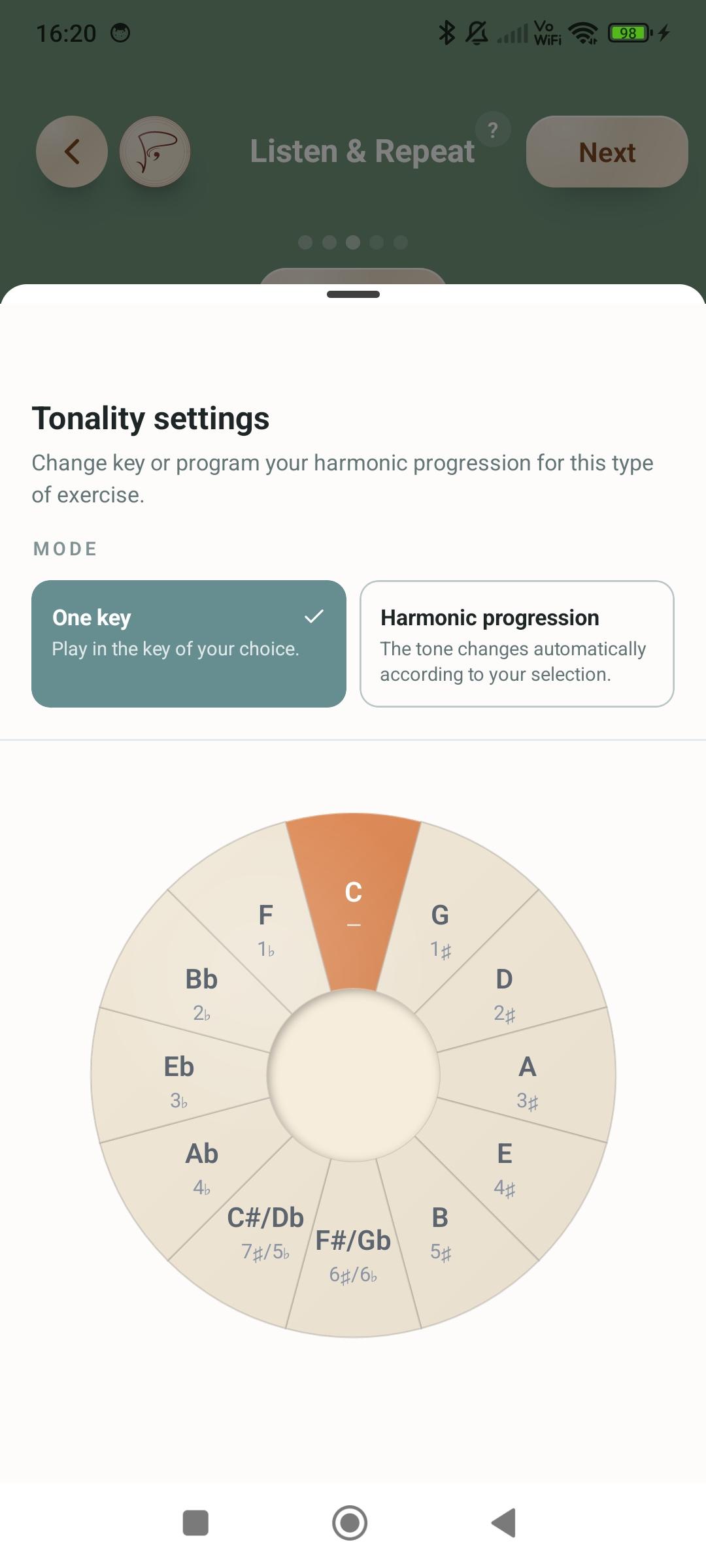
A fixed key
By default, each volume is built around a reference key. For example, the first volume primarily uses C major.
However, it is possible to work on exactly the same exercises in another key.
This approach is ideal for deepening a particular key and gradually building solid benchmarks.
For example, we can decide to redo an entire volume in E major, F♯ major or any other key.
We find the same exercises, the same educational objectives and the same progression, but in a new harmonic environment.
The progression of keys
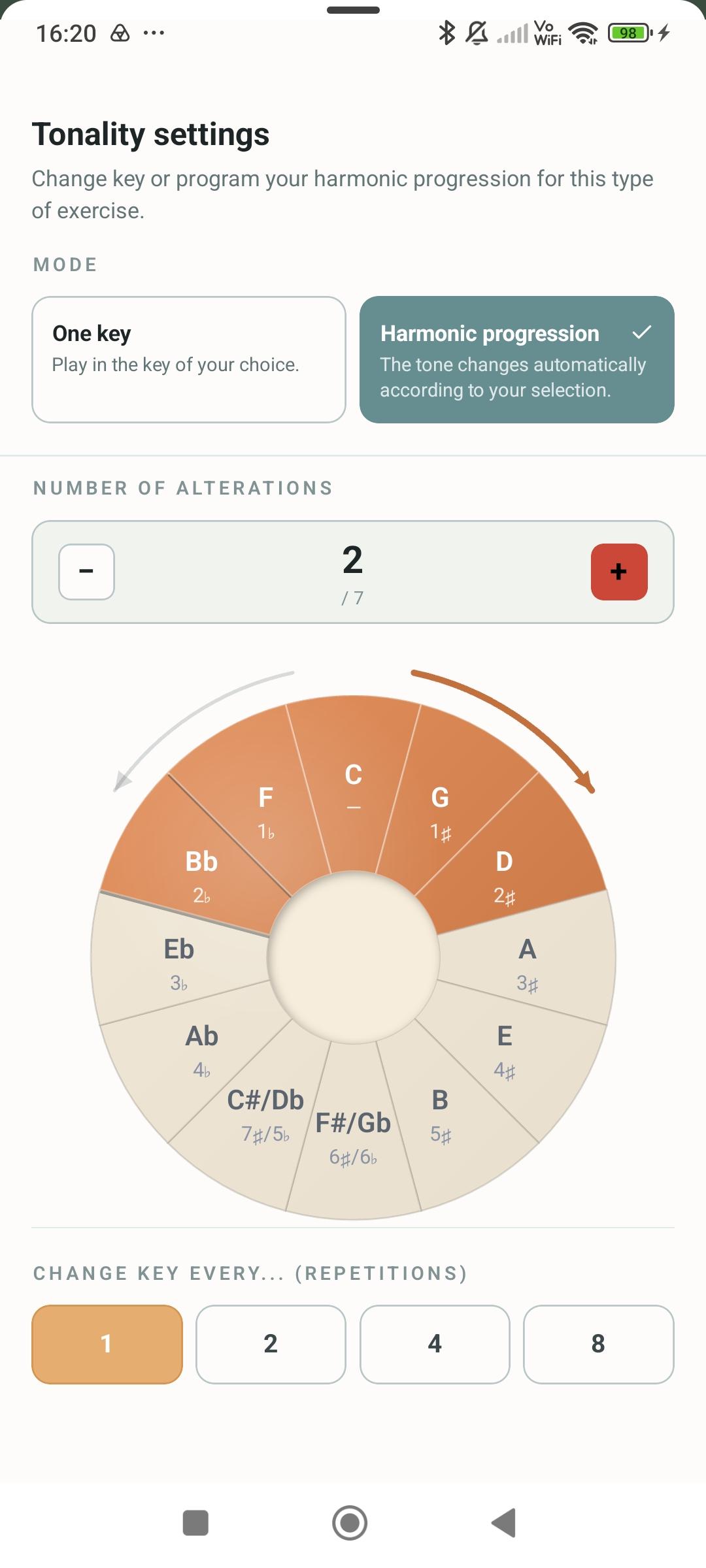
It is also possible to automatically change the key over repetitions.
This is where the same exercise takes on a whole new dimension.
We choose:
- the maximum number of accidentals to use;
- the direction of progression in the circle of fourths or fifths;
- how often the key changes.
Pulse then takes care of automatically evolving all exercises of the same type according to these settings.
No need to change the key before each exercise: you can concentrate solely on listening and playing.
A difficulty that evolves with the level
The settings allow you to adapt the difficulty level to the objectives.
We can start with just one or two alterations in order to gradually build new benchmarks.
Then gradually expand until you cover all twelve keys.
You can also decide that the key changes with each repetition, or on the contrary keep it for several passages before moving on to the next one.
These settings are saved for each exercise family in order to create a consistent working environment.
Much more than a simple transposition
Changing your key isn't just about playing the same notes higher or lower.
This feature develops several skills in parallel.
Develop the ear
When the key changes regularly, we learn to hear the relationships between notes rather than memorizing a precise sequence.
We anticipate the new fundamental, we hear the intervals more easily and we gradually develop stronger relative pitch.
Develop the marks on the instrument
The same musical idea must be found in different positions.
We learn to construct a major chord, a pentatonic or a melodic phrase in all keys.
The positions gradually become natural.
Develop responsiveness
When the key changes automatically, you have to be ready before the next passage even begins.
We learn to anticipate, to hear the next key internally and to react quickly.
This ability is valuable when playing with other musicians.
One exercise, several objectives
Let’s take the example of a musician who has already practiced for several years.
Its main objective is to develop rhythmic placement and ear.
It therefore covers the first chapters of Pulse.
For listening and repetition exercises, it programs:
- a change of key with each passage;
- the twelve keys;
- a progression in the direction of fourths.
The rhythm studied remains exactly the same.
But at each repetition, he must immediately hear the new key, anticipate the next fundamental, find his bearings on the instrument and sing or play without hesitation.
A very simple exercise then becomes excellent training for integrating the cycle of fourths, strengthening the ear and developing reactivity.
For longer exercises, such as variations or certain improvisations, he chooses, on the contrary, to limit the work to keys with few alterations.
He thus gradually consolidates his benchmarks before broadening his playing field. The same educational path therefore naturally adapts to the level and objectives.
Some training ideas
The key change feature can be used in many ways.
Constructing the cycle of fourths
- Change with each pass.
- The twelve keys.
- Singing or listening exercises.
Objective: naturally integrate the cycle of fourths.
Build your chords in all keys
- Two or three alterations at most at the beginning.
- Instrument exercises.
Objective: quickly find the same agreements in different contexts.
Develop the ear
- Frequent change of key.
- Transplanting exercises.
Objective: to hear the relationships between notes rather than memorizing a position.
Deepen a key
- A single steady key for several days or weeks.
Objective: build solid benchmarks before continuing the exploration.
A method that evolves with the level
At the start of the journey, the key is above all a reassuring framework.
With experience, it becomes a formidable training ground.
With a few adjustments, an already known exercise can become a new challenge, without changing its educational objective.
It is this philosophy that guides Pulse: to offer a method progressive enough to support beginners, but flexible enough to continue to help more experienced musicians progress.